
— zen in Norwegian


Vegar Svanemyr

I became interested in Zen as a teenager, after finding the ancient Chinese book Tao Te Ching in the library. After reading a few books and trying my hand at meditation myself, I eventually realized that I couldn't get anywhere on my own and had to find a real teacher.
In 2002, I went to the United States to attend a retreat for the first time, with Genpo Roshi and his Kanzeon sangha in Salt Lake City, Utah. The experience was profound and good, and made me decide to move there and study full-time, while working in video production and IT on the side. When the Kanzeon group was discontinued in 2011 [CHECK: year], I moved with my pregnant wife Christy to San Francisco to work with Integral Coaching with James Flaherty and New Ventures West.
After Christy passed away suddenly in 2013, barely a year after our daughter was born, I returned to studying Zen — this time with Daniel Doen Silberberg Roshi in San Francisco, who remains my teacher. In 2021, I moved back to Norway with my daughter, and now we are happily settled in beautiful Oslo with our dog Tenzing.
In recent years, I have founded and run the voluntary organization Foreningen, and researched and written about history, culture and consciousness. I am currently working on a book about Zen in Norwegian, among other things. I love practical things, being outdoors and active. I have done crossfit, BJJ and boxing — currently I am studying tai chi with Pamela Hiley and the Norwegian Taiji Center.
I received my teaching authorization in the Zen lineage from Doen Roshi in 2025, and am both grateful, happy, and humbled to have inherited this deep and rich tradition — and to carry it forward in Norwegian."
Vegar Ryoen Svanemyr

Lost Coin Zen is an international practice group, founded by Daniel Doen Silberberg Roshi, and led by Rebecca Ryuen Long Okura Sensei. We meet weekly on Zoom, and gather for retreats several times a year.
Our members come from diverse backgrounds and We learn with and from each other through long-term friendship and community, and the Lost Coin method's focus on training through the body, emotions, and mind.

Rebecca Ryuen Long Okura
Rebecca Sensei er nestlederen for Lost Coin Zen, har studert Zen i over 20 år og er Doen Roshi's første etterfølger. Hun er utdannet advokat fra Georgetown University, og har jobbet for statlige departementer, ideelle organisasjoner, og advokatfirma i Washington, D.C. før hun startet sitt eget advokatfirma i 2004. Rebecca er dypt entusiastisk når det kommer læring. Hun driver blant annet sitt eget bibliotek, samler på gamle bøker, fekter på nasjonalt Amerikansk nivå, og snakker og skriver flytende Mandarin Kinesisk.

Daniel Doen Silberberg
Doen Roshi is the founder of Lost Coin Zen. He was born to Jewish parents in Germany after World War II and moved to New York City as a child. He studied George Gurdjieff's Fourth Way from the late 1960s, but after becoming a teacher there he still felt he had more to learn. From the early 1980s he therefore became a Zen student under Taizan Maezumi Roshi and John Daido Loori, with whom he helped build the Zen Mountain Monastery in Mt. Tremper, New York.
He received dharma transmission from Genpo Roshi in 2002, holds a master's degree in English literature and a doctorate in psychology. He is an experienced chess player and has had careers as a psychologist, Zen teacher, and jazz musician. He lives in San Francisco with his wife Caryn and their dog Chance, where he pursues further studies and recordings of jazz.
The tradition
The Zen tradition as it comes through Lost Coin Zen traces back to Gotama Shakyamuni, also known as the Buddha, who lived in India around 500 BC. As his teachings moved from India to China around 500 AD, it merged with Daoism to become what we know as Zen. From there, it passed on to Japan in the 13th century, where it deeply influenced the samurai tradition.
Our branch of Zen came to the United States with the now legendary Taizan Maezumi Roshi, who left Japan to establish the Zen Center of Los Angeles in 1967. Both Genpo Roshi and Doen Roshi studied directly with Maezumi Roshi.
Through Daniel Doen Roshi's Lost Coin Zen approach, we have now united the traditional methods with Gurdjieff's Fourth Way, and other Western traditions within psychology, art, and music.
These are some of the people who have shaped this path and the method we can benefit from today:
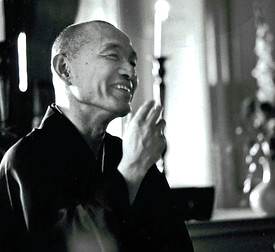
Hakuyun Taizan Maezumi
Maezumi Roshi (1931-1995) moved to the United States from Japan in 1956. He was deeply admired as a “teacher of teachers,” and contributed immensely to the establishment and cultivation of Zen Buddhism in the United States and Europe. He received dharma transmission from Hakujun Kuroda Roshi in 1955, and later also received teacher recognition from Koryu Osaka Roshi and Hakuun Yasutani Roshi, making him the holder of three different lineages in the Zen tradition. He founded the Zen Center of Los Angeles (ZCLA) and recognized twelve of his students as successors. The umbrella organization White Plum Sangha, which includes all of his successors and their students, and of which Lost Coin Zen is also a part, now has more than 200 Zen teachers and thousands of students worldwide.

John Daido Loori
Daido Roshi (1931-2009) received dharma transmission from Maezumi Roshi in 1986 as his fourth successor. He served in the United States Navy from 1947 to 1952, was a professional photographer, passionate outdoorsman, and author of more than 20 books. In the early 1980s, he founded and built up the influential Zen Mountain Monastery in the Catskill Mountains of New York, together with Doen Roshi and others.

Dennis Genpo Merzel
Genpo Roshi was born in Long Beach, California in 1944. He competed in swimming, was an All-American water polo player, bodyguard, and school teacher before becoming a student of Maezumi Roshi at ZCLA in 1972, and his second successor in 1980. He founded and led the Kanzeon Zen Center from 1984 until its dissolution in 2011, developing the Big Mind process as an amalgam of Zen and Jungian therapeutic techniques.

Willem Nyland
Willem Nyland (1890-1975) was born in Utrecht, the Netherlands, and came to know Gurdjieff's teachings in New York in the 1920s through A.R. Orage. He remained in direct contact with Gurdjieff for 25 years until his death in 1949. Mr. Nyland was known for his clarity and seriousness as an early student of Gurdjieff in America. He felt it was necessary to apply the Fourth Way work to daily life rather than just thinking or feeling the ideas. Mr. Nyland was one of Doens Roshi's principal teachers in this tradition.